The California Decorative Style
Published by the Two Red Roses Foundation, June 12, 2015
 Arthur and Lucia Mathews were among the leading practitioners of the so-called California Decorative Style, a term coined to define the work of a group of late-nineteenth-century artists who combined the allegories and classicism of the American Renaissance with the bright colors and distinctive topography of their native California. Together the Mathewses presided over the San Francisco art world at the turn of the last century, and when their universe was destroyed by earthquake and fire in 1906, they worked together to ensure that art and aesthetics would play a role in the rebuilding process. Along with local businessman John Zeile Jr., they founded the Furniture Shop, providing commercial and residential clients with designs, furnishings, and decorative objects that would allow them to incorporate the uplifting power of art into their lives.
They developed an artistic style that drew inspiration from the California landscape with a devotion to the high art of the classical past. At the beginning of the last century California was envisioned by its inhabitants as a new Arcadia, a transplanted Mediterranean zone where the pure arts would flourish, over the harsh and ugly aspects of industrialism, in the full light and warmth of the sun.
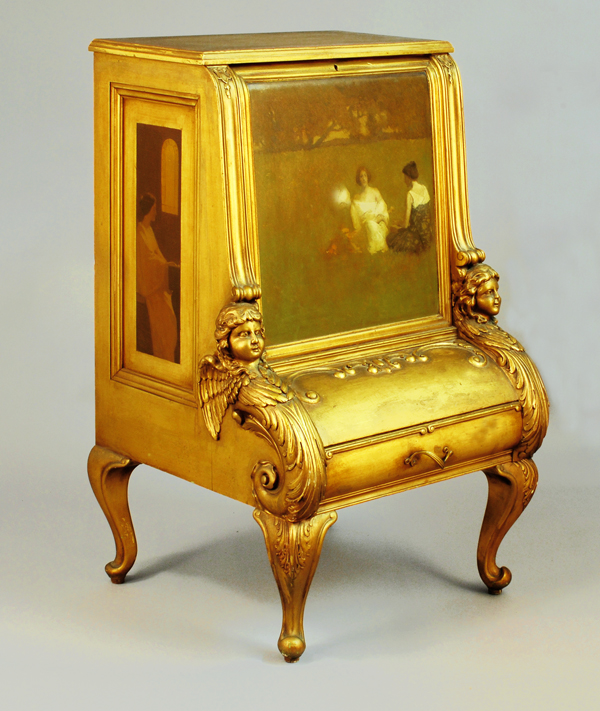
Arthur Mathews reputation as a brilliant muralist made him a favorite of San Francisco's most wealthy and affluent residents, affording him significant residential commissions. Among his most prominent clients was Francis M. Smith, whose fortune was made through his discovery and marketing of Borax. Around 1900, Smith presented Arthur Mathews with a commission to decorate an ornately carved and gilded piano and a music cabinet for the drawing room of his prominent Oakland estate.
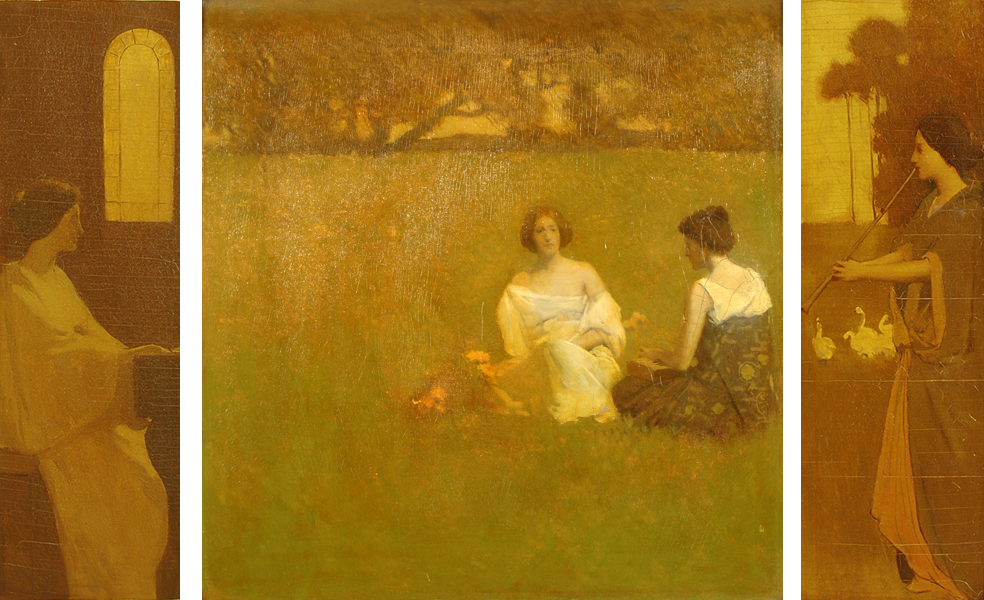
In his comprehensive retrospective The Art of Arthur & Lucia Mathews, Harvey L. Jones describes the subjects of the music cabinet:
"For its two side panels, he painted figures to express the concepts of sacred and profane with two women dressed in Grecian-inspired gowns and seated on the grass before a grove of trees. The Arcadian spirit of the Arts and Crafts style in these three panels corresponds more closely with Mathews' easel paintings of the period and certainly anticipates his future involvement with decorated furniture."
The Two Red Roses Foundation is privileged to own this Mathews' music sheet cabinet, an extremely rare find since almost all extant Mathews' decorative objects and furniture are in the collection of the Oakland Museum of Art.
Greene & Greene Stained Glass Windows:
Returned From the Huntington Art Museum

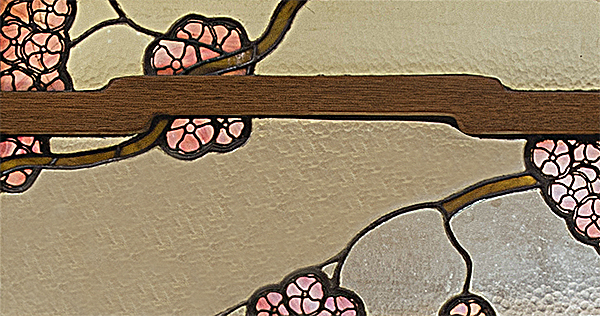
Five beautiful stained glass windows from the dining room of the Mrs. Mary E. Cole House, 301 South Orange Blvd, Pasadena, California, were returned to the Two Red Roses Foundation's collection after having been on loan to the Huntington Museum of Art in Pasadena where they were displayed in the Huntington Library-Steele Gallery.
The Mary E. Cole house, right next door to the Gamble House, in Pasadena, California, was designed by famed architects Greene & Greene in 1906. The Cole's large, elegant bungalow style building featured a prominent porte cochere on the front and an open porch on the second story above the first story terrace at the rear. The lower half of the chimneys and porte cochere supports are constructed with arroyo boulders, presenting both an artistic and rustic look. The interior was heavily ornamented with Rookwood tiles and brick for all the fireplaces, leaded art glass panels and handsomely finished woodwork.
By mid-1906 the Greenes were approaching their full creative powers as architects. Fifteen draftsmen were employed by the firm. Leonard Collins served as head draftsman and the majority of them assisted in the interior decorative arts drawings. Charles Greene would execute pencil sketches of his furniture designs and John Hall would produce the finished drawings for production. The collaboration of Emil Lange, Peter and John Hall and the designs of Charles and Henry Greene culminated in their five masterpieces: the "Ultimate Bungalows" designed from 1907-1909. These five commissions established their international reputation and are the signature designs most recognized by the general public today. The commissions included gardens, lighting, furniture, rugs, fireplace tools and other decorative objects that created the complete concept of an architect designed home. The five designs each had custom furnishings produced by the Hall brothers and represent the finest examples of Greene and Greene design and craftsmanship.
The Cole House windows will be displayed on the Museum's second floor's Architects' galleries along with many other important objects by Frank Lloyd Wright, Sullivan and Adler, Niedecken, Maher, Greene and Greene and Maybeck.