
Lights on the Prairie: The New Aesthetic
Published by the Two Red Roses Foundation, October 21, 2015
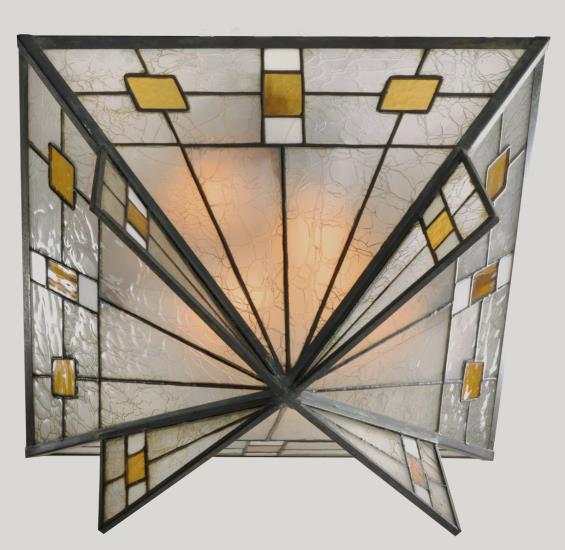
The development and emergent use of the electric light bulb in the late years of the nineteenth century prompted designers and craftspeople to consider a host of ways in which the new light source might be utilized not only for practical application, but for artistic affect. The bare bulb may have spoken directly to the triumph of this new technology, but the proponents of the Arts and Crafts movement saw instead opportunities for diverse expressions that suggested everything from the glow of sunlight as seen in the lamps of Louis Comfort Tiffany to the architectonic echoes of the Prairie School designers. The latter group’s predilection for art glass windows as well as use of the electric bulb for indirect and direct lighting reflected a sophisticated blend of influences – including Japanese aesthetics – that ultimately helped them realize a modern architectural expression for the new century. Lighting, both natural and artificial, was an integral component of this effort.
The Two Red Roses Foundation collection contains a rich selection of early twentieth century lighting fixtures that will be the subject of a forthcoming publication “Radiance: Arts and Crafts Electric Lighting: Beautiful, Useful, Inevitable” by David Cathers. Among these works, electric lamps by Frank Lloyd Wright, George Mann Niedecken, and George Washington Maher represent the work of the Prairie School alongside superior examples by lesser known architects and designers. The shared aesthetic of typically boxy, lantern-like leaded shades with geometric designs including pronounced linear elements provided a vocabulary of motifs that were eagerly worked and reworked by designers known and unknown, including those of one of the Foundation’s leaded glass chandeliers that loosely recalls Wright’s own ceiling fixture designs, notably those of the Francis W. Little House (1902) in Peoria, IL. This particular fixture was reputed to have been located in the William Prindle House (1904-05) in Duluth, Minnesota, a residence that included eclectic interiors created by John Scott Bradstreet (1845-1914).
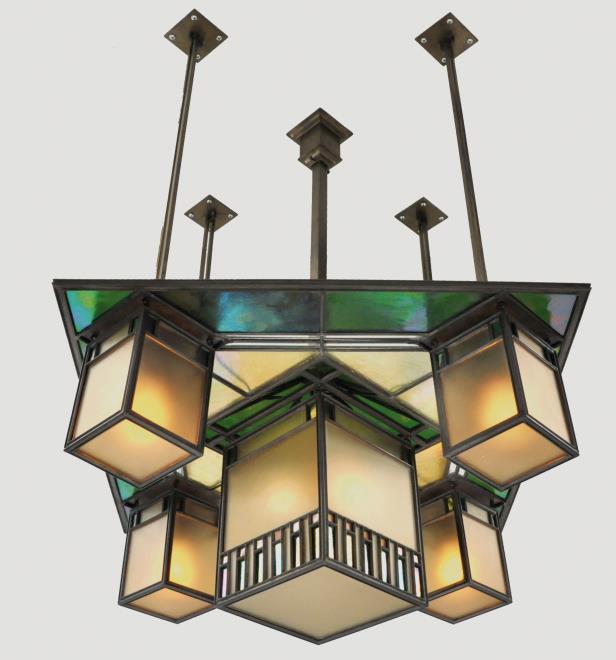
Colored and iridescent glass, metal.
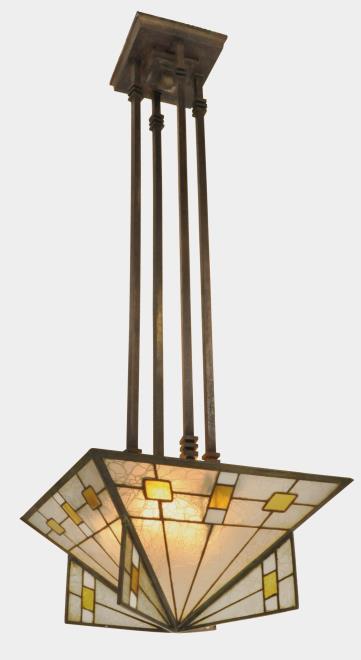
Another hanging fixture, designed by architects Percy Dwight Bentley (1886-1968) and Charles Albert Hausler (1889-1971) for the Emil T. Mueller House (1915-16) in La Crosse, Wisconsin utilizes an inverted pyramid-form leaded shade decorated with rectangular and square colored glass elements to provide a design in harmony with the Wright-influenced design. Bentley was certainly familiar with the work of Wright and his design collaborator Niedecken, having worked with the latter in the creation of the furnishings and fixtures for the Henry A. Salzer House (1912), also located in La Crosse.