
Collection Highlight: Louis H. Sullivan and the Chicago Stock Exchange Stairs
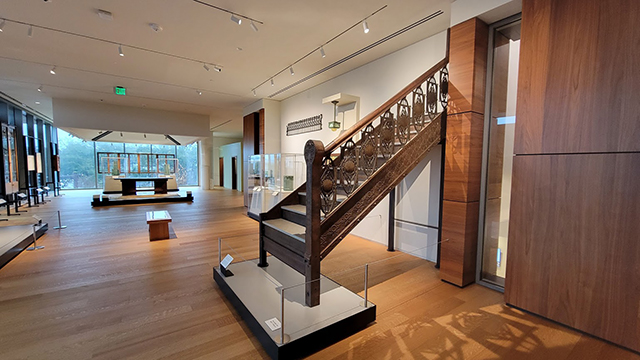
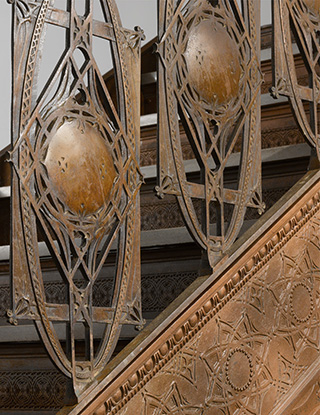 This rare, decorative staircase, designed by the firm of Adler and Sullivan in 1894, is one of the few remaining artifacts from the legendary Chicago Stock Exchange. The commercial structure was a landmark of American architecture in both design and construction. The 13-story Exchange was an early example of the American skyscraper, built of fireproof metal and terra cotta. In terms of design, all elements – from stone, terra cotta, and glass to murals and metalwork – were adorned with Louis Sullivan’s luxurious ornament. Despite unsuccessful preservation attempts, the Exchange was demolished in 1972, however some pieces remain and these stairs stand as a testament to Sullivan’s sophisticated design.
Louis H. Sullivan was an American architect, regarded as Chicago’s “Father of the Skyscraper” and the spiritual father of modern architecture. He had an eye for attention to detail and the use of ornamentation throughout his projects.
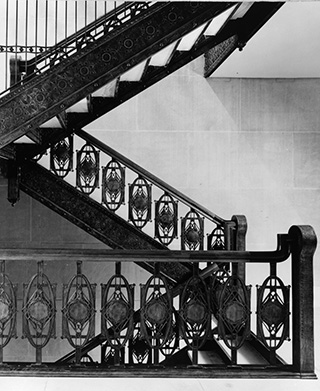 Sullivan attended a number of architectural schools before working as a Draftsman for different firms in Chicago, where he was eventually introduced to his future business partner, Dankmar Adler. He joined Adler’s firm in 1879 and at the age of 24, Sullivan became a partner. Adler and Sullivan worked collaboratively for 14 years, producing over 100 buildings – many considered landmarks in American architecture. Unlike many of his peers, Sullivan’s ideal of “form follows function” meant that modern forms did not have to abandon ornament. He created sumptuous yet ordered designs inspired by nature and the curving forms of Art Nouveau and Celtic art, but structured within a tight geometric framework.
Found on the 2nd floor, in MAACM’s Architects Gallery, this staircase exemplifies Sullivan’s influential design concept and is a stunning piece of architectural design history.