Collection Spotlight New Acquisition: Frank Lloyd Wright Urn from the Edward C. Waller House
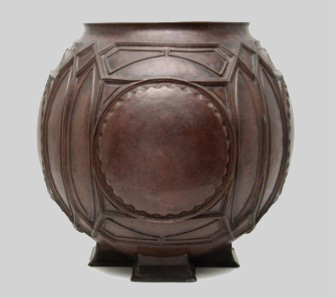
This spherical copper urn, 18” high and 19” in diameter, is in its original red-brown patina, adorned on four sides with raised medallions with dimpled edges. The urn is bordered on top and bottom with elongated hexagonal and diamond shapes, and is supported on a base of four squared sections. The urn in the TRRF collection is the only known sample which contains its original galvanized tin liner with loop handles, marked E. C. Waller in pencil.
Wright designed two models of this urn. The primary difference between the two models is that the later examples, referred to as the “open” version, lack the additional “bow-tie” decoration within each upper and lower hexagon that was featured in the earlier design. This seemingly minor design change created a more cohesive motif and significantly altered and enhanced the urn’s overall impact by further reinforcing its bold, spherical form.
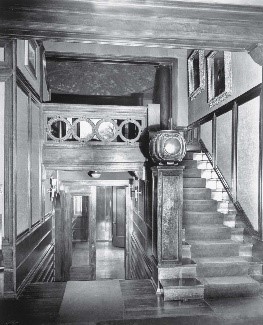
The sample in the Two Red Roses Foundation’s collection is one of the two designed for businessman and real estate developer Edward Carson Waller, who was one of Wright’s earliest and most important patrons. In 1899 Waller hired Wright to extensively remodel his family home in River Forest, IL, a small suburban community 20 miles west of Chicago. Period photographs show one of the urns placed atop the newel post of the entry hall’s stairway. Its dramatic design echoes the circular pattern of the railing.
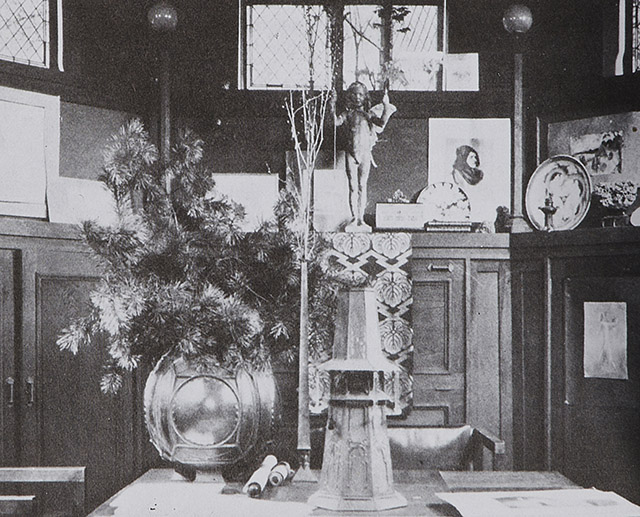
In addition to the pair for the Waller House, others might have also been made for the Joseph and Helen Husser House, Chicago (1899) and the Isadore Heller House, Chicago (1896). “Open” versions were produced for the Sarah Lawrence Dana House, Springfield, Illinois (1902), the Avery Coonley House, Riverside, Illinois (1907), Browne’s Bookstore, Chicago (1908), and Unity Temple, Oak Park, Illinois (1908). Although the exact number of urns produced is unknown, it is believed that 16 were made and 6 documented examples are extant. An example of the earlier version appeared in Wright’s home and studio in Oak Park, Illinois shown along with Wright’s “Weed Vase”.
Some of the extant samples of this urn are in the collection of some of the world’s leading museums, including the Metropolitan Museum of Art, New York, the Victoria and Albert Museum, London, and the Los Angeles County Museum of Art, Crabtree Farms, and now in the Museum of the American Arts and Crafts Movement.
This urn, along with our “Weed Vase”, will be shown soon at a special event that will highlight numerous very important acquisitions made by the Two Red Roses Foundation over the past year.