
New Acquisitions: Frank Marshall
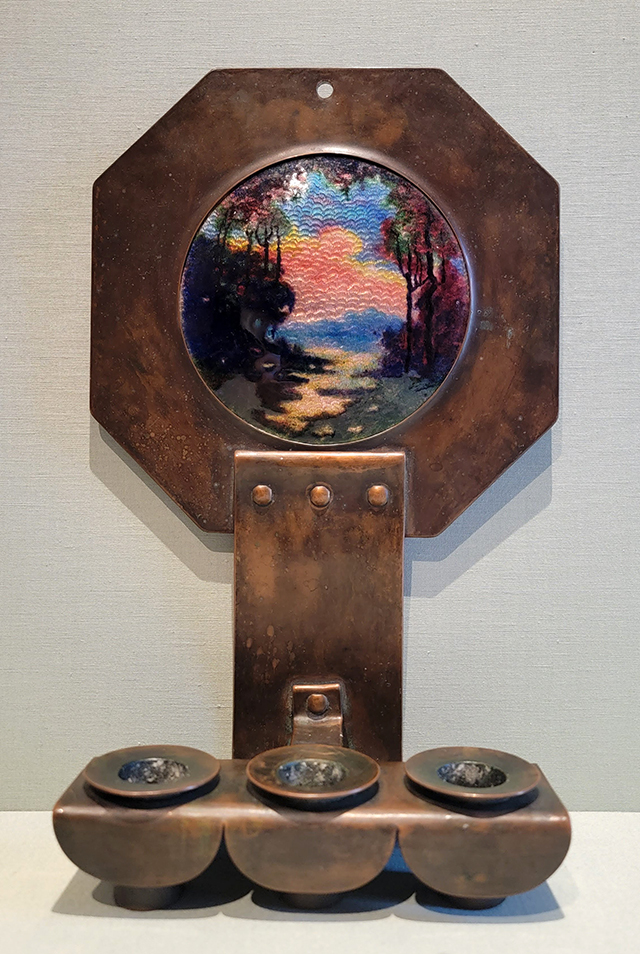
Frank J. Marshall, American, 1884-1975, designer and maker
Copper and enamel
This stunning candelabra and smartly decorated box created by metalsmith and enamellist artist Frank Marshall will join other metalwork objects in the new exhibition opening soon. While Marshall is known for his delicately decorated boxes, the candelabra is the largest known piece of art attributed to him. Both objects show the depth and breadth of skill of this artist and his metalworking abilities.
Blending Arts and Crafts metalworking with exquisite enamel artistry, Frank Marshall’s masterpieces are recognizable through his distractive peacock motifs, the use of opalescent enamels in his Limoges works, and his incorporation of fine chasing and hand hammering below the enamel surface, creating rich textural impacts and visual depth. Perhaps most notable for his enameled decorative boxes, which were fashionable in the early years of the twentieth century, his use of the landscape motif in enamel on the candelabra shows the way he could adapt this style to a wider array of objects.
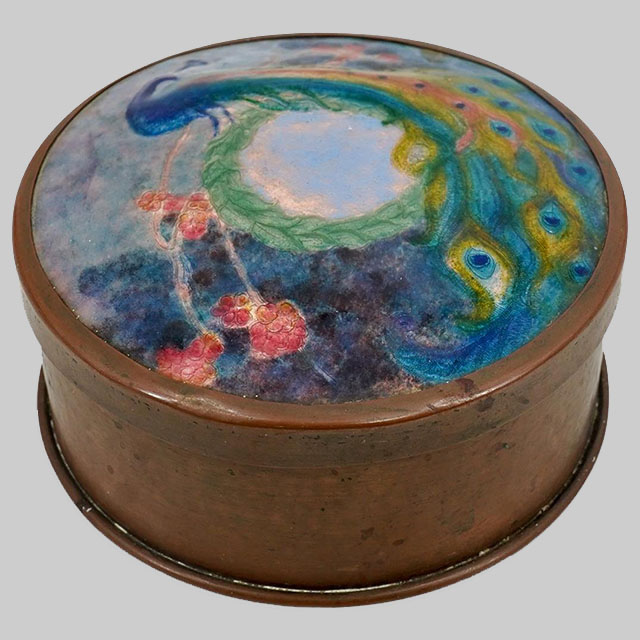
Frank J. Marshall, American, 1884-1975, designer and maker
Copper and enamel
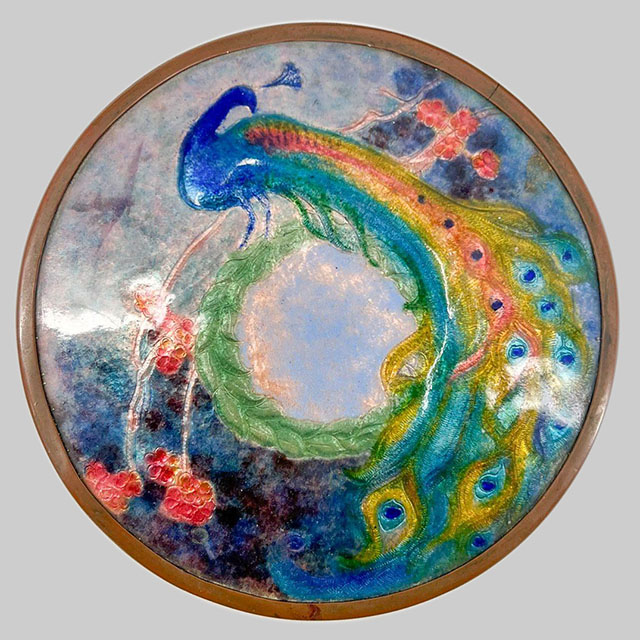
Frank Marshall attended the Massachusetts Normal Art school in Lowell where he studied metalsmithing and enameling under Laurin Martin. In 1907 he became a member of the renowned Society of Arts and Crafts, Boston. That same year, he entered two copper items into the Society’s exhibition where his work was praised by American Arts and Crafts contemporaries. By 1913, he was awarded the coveted title of Master in the Society of Arts and Crafts, Boston. He continued to exhibit his work in Boston, Chicago, and New York. Although his works throughout the years have featured landscapes, flowers, mermaids, fruit, trees, and figures, he is best remembered for his realistically enameled peacocks, in profile, perched on tree branches with impressionistic backgrounds.