New Acquisition by Samuel Yellin
The upcoming exhibition, These Humbler Metals, features many copper objects, the most popular material of the Arts and Crafts era. While most artisans during the movement preferred the warm hues, pliability, and availability of copper, for Samuel Yellin, iron was his metal of choice.
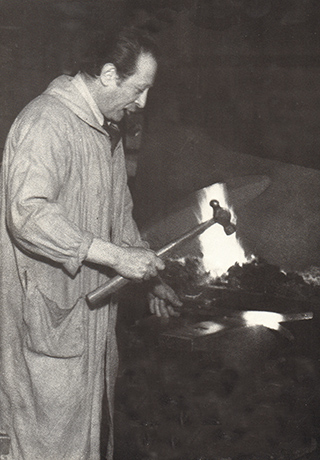
Samuel Yellin (1885-1940), the foremost ironsmith of the twentieth century, was born in Ukraine and immigrated to Philadelphia in 1905. After studying at the Pennsylvania Museum School of Industrial Art, he opened his own firm in 1909, the Samuel Yellin Metalworkers Co. in Philadelphia. In the late 1920s and 1930s, the studio received over 1,200 commissions and employed over 250 workers. During this time, Yellin forged an extensive body of decorative ironwork, handwrought by himself and the blacksmiths in his studio executing his designs. His work adorns a large number of public and private buildings throughout Philadelphia and the United States. Notable commissions include Harvard and Princeton Universities, The National Cathedral, and The Cloisters at the Metropolitan Museum. Yellin’s firm received large commissions like grills, gates, and railings for libraries, universities, banks, and museums, including this gate which will be on display in our upcoming metalwork exhibit.
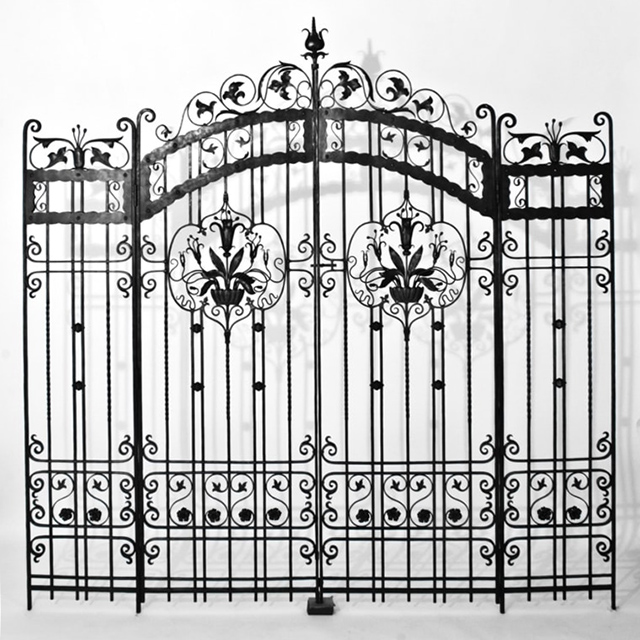
From a private residence in Wynnefield Heights, Philadelphia, and recently purchased by the Two Red Roses Foundation, the above gate is over 6-feet tall. It is made of wrought iron, and is adorned with flora-form motifs along the top, on the left and right doors, and in a repeating pattern on the bottom third of the gate.
Samuel Yellin died in 1940, however his studio remained in his family and is currently operated by his granddaughter, Clare Yellin. Yellin’s designs follow the shared values of the Arts and Crafts movement – simplicity of form, minimal decoration, functionality and an emphasis on the beauty of common materials. Enjoy this object and over 300 more metalwork items from other artisans, on display in These Humbler Metals opening soon at MAACM.