
A Unique Masterpiece The Newcomb Pottery Iris Blossom Lamp
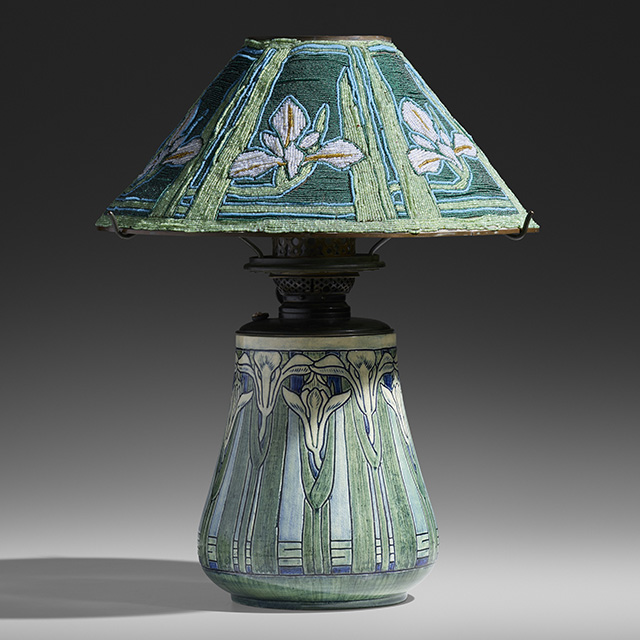
Mary Given Sheerer (American, 1865-1954), designer
Newcomb College Pottery, New Orleans, Louisiana, maker
Glazed earthenware, patinated metal, beaded shade
For those passionate about the American Arts and Crafts movement, especially for aficionados of the Newcomb Pottery, Mary Sheerer’s Iris Lamp is an unparalleled and iconic object. Its carved and glazed base and jewel-like glass-beaded shade with iris blossoms embody all that the Arts and Crafts movement represents and testifies to the artist’s creative ability and her selfless commitment to labor. In accord with William Morris’s dictum, the Iris Lamp unites the useful and the beautiful: it sheds light in the darkness and brings joy to the beholder. Comparable Newcomb lamps cannot be found. Indeed, as far as is known, this lamp is the only extant example of such work from the Newcomb Pottery. While there are a few Newcomb lamps with metal shades, none with glass-beaded shades have survived. There are contemporary references to other shades with glass beads, and one was illustrated, but the Iris Lamp remains unique.
When it was first seen in New Orleans, probably before it was sent to the St. Louis World’s Fair of 1904, it was described at great length and highly praised:
A handsome and most original piece of work is attracting a great deal of attention. It is a lamp made, of course, of Louisiana clay, in the deep bluish gray that has secured such favor for the Newcomb pottery. The great beauty of the lamp, however, is the shade, and here Miss Sheerer, who made it, has shown wonderful originality. There has recently been a great revival of the old-fashioned bead work so beautifully done by our grandmothers fifty years ago. Miss Sheerer has applied the idea of bead work to lamp shades. The lovely overhanging shade of the lamp is made entirely of dark bluish gray beads, as fine almost as the head of a pin; they are strung on wire and formed into the shape of the shade so peculiar to the Newcomb lamps. The design around the shade is the fleur de lys. It is beautifully wrought, and the lamp is remarkable not only for the originality of the application of beads to lamp shade purposes, but the discovery that Miss Sheerer has made of a material which will properly shade the lamp without emitting the great heat so common in most shades. The lamp is admired by all visitors to Newcomb College.
While the first craft endeavors at Newcomb focused primarily on china painting and pottery, other media were gradually introduced. Theirs was an expanding empire, and metalworking was officially introduced to the curriculum in 1900. Thus, making lamps with pottery bases and metal shades brought together two of the school’s basic crafts.
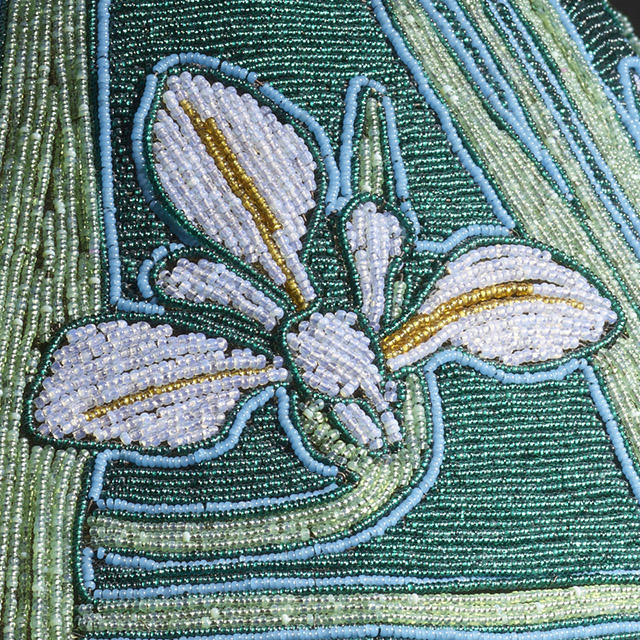
While at Newcomb College it was standard practice to use combinations of pottery bases and metal shades for lamps, as well as fine mesh screens as underlayers for shades, Mary Sheerer’s Iris lamp’s inclusion of glass beads was truly novel.
Mary Sheerer, a highly talented professional in every sense of the word, took on an enormous project in committing to this beaded shade. The patience necessary to gather each bead on the wire thread and sew it in place required a great commitment. The endless hours expended on this repetitive task must have been exhausting, and it is not surprising that the lamp was still not yet ready when the Newcomb display was sent off to the 1904 St. Louis World’s Fair.
A large measure of this lamp’s artistic success, beyond its material aspects, is certainly due to its related yet subtly different floral designs. The base represents a modern approach to decoration, then generally termed conventionalization. Although clearly recognizable as irises, the plants are arranged hieratically, constrained both frontally and symmetrically. The blossoms are in a stepped formation, on two alternate levels, and form a richly organic border. Below them, a series of broken horizontal dashes establishes a sense of ground but as abstract pattern, rather than depicting spatial depth. This was a favorite device of Arthur Wesley Dow, the leading American proponent of conventionalized design.
While the design of this lamp was conceived by Sheerer, Dow’s name must also be intoned. He brought together the tenets of both Japanese and modern Western art and forged them into a viable visual language. Through his classes in New York and Ipswich, and his publications, especially his enormously influential book Composition, he taught American painters, printmakers, and designers to transform visual data into a language of balanced, abstracted forms in harmonies of tasteful tones.
Sheerer’s indebtedness to Japanese printmaking, via Dow’s teachings, is especially apparent in the arrangement of the shade’s floral design. Each panel features a striking depiction of a lily flower and leaves—all pushed to the surface so that there is no spatial depth and adjusted to the side in a dramatically asymmetric manner. As Dow advised in his writings, Sheerer concentrated on the composition and not on botanical accuracy.
The work numbers underneath the vessel—"AD 130”—indicate that the decoration of the pottery base must have been begun in 1903-04. Sheerer was still at work on the shade in the first months of 1904 since it was not yet ready for inspection by the April submission deadline. But it was finished by May 23, when Ellsworth Woodward wrote to Frederick A. Whiting asking that this lamp and other recently executed products from the Newcomb workshops be allowed to belatedly join the college’s display. Of the lamp, Woodward wrote that it was “the most distinguished product of the Newcomb Pottery to date… one of the most satisfactory and permanent workmanlike bits of handicraft that I have seen yet from any source. So far as my expertise goes with all this sort of thing, it is unique.” The lamp was accepted and shown at the St. Louis World Fair and as is evident, it indeed proved to be the most distinguished product of the Newcomb Pottery.
Essay by Dr. Martin Eidelberg