
New Acquisition Spotlight: The Gorham Art Nouveau Martelé silverware
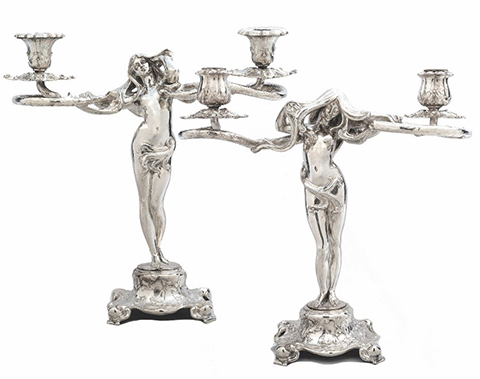
Edwin E. Codman, American, 1876-1955, designer
Gorham Manufacturing Company, Providence, RI, manufacturer
The Museum of the American Arts and Crafts Movement (MAACM) recently acquired through a purchase from the Two Red Roses Foundation a collection of Martelé silverware made by the Gorham Manufacturing Company.
Officially introduced at the influential Paris Exposition Universelle in 1900, the Martelé line is now considered one of the most important American expressions of the sinuous Art Nouveau style of silverware. The trade name Martelé derives from the French verb "marteler" (to hammer), denoting the distinctive hand-hammered surface of the silverware and underscoring the significance placed on superior craftmanship and innovative design.
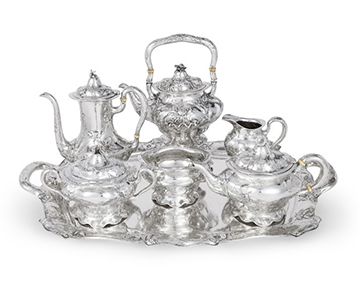
Gorham Manufacturing Company, Providence, RI, manufacturer
The Martelé line included Gorham's most expensive and most desirable silverware line. At a time when all silver items were being made by machine, Gorham brought together their most talented silversmiths and opened a new department, under the direction of designer William C. Codman, lasting from 1896 through the 1930s, to produce Martelé silverware. This completely handwrought production was separated by Gorham's commercial line and its pieces were one-of-a-kind, completely hand-made, very expensive objects for selected customers.
Production included bowls, tankards, vases, chambersticks, claret sets, letter openers, candlesticks, porringers, mugs, cigar lighters, inkwells, centerpieces, tea and coffee sets. Martelé was entirely hand raised, chased, and engraved, with the feet and bases of each item which did not lay flat made as an integral part of the object. Hammer marks were visible hand work, evident even with polished finishes.
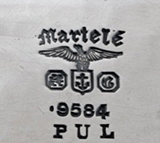 Early production was made of sterling silver (.925 fine). From 1898 until 1905 a more malleable alloy (.950 fine) was used to meet French strict requirements for the alloy composition of silver imports. The purity was raised again during 1905 to .9584, likely to match the British Britannia standard to ensure that the Martelé line would be produced with the highest grade available.
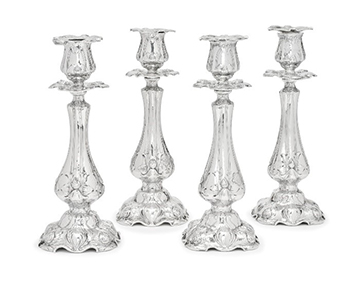
Gorham Manufacturing Company, Providence, RI, manufacturer
As the primary tenet of the Art Nouveau style was “Art in nature; nature in art,” the designs of the Martelé line were inspired from natural sources as vines, foliage, flowers, seaweed, and even small animals. Such inspiration was not supposed to copy natural appearances but to simplify, abstract, and interpret them. The practical application of such thinking produced objects that held in common a swaying, undulating rhythm and energy-charged contours. Martelé objects were given organic silhouettes and often displayed everted lips with rippling edges and elegantly chased flowers and foliage.
The Two Red Roses Foundation collection has collected hundreds of silverware and jewelry objects, never shown before, which will be displayed in the museum galleries soon.