Collection Spotlight: Arlyn Table
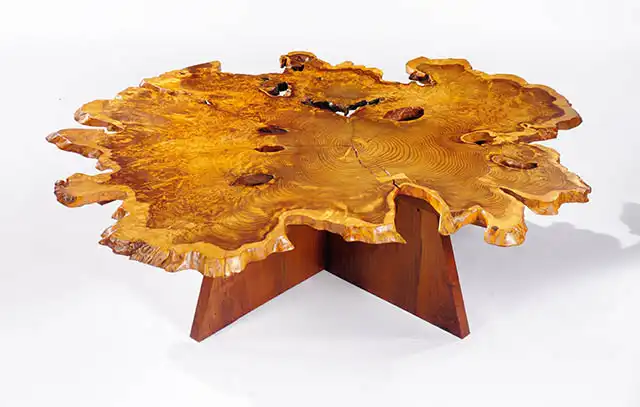
George Nakashima, American, 1905-1990, designer and maker
Redwood burl, walnut
Visitors to the Museum of the American Arts and Crafts Movement in St. Petersburg, Florida can see the legendary Arlyn table, arguably the most important piece of furniture ever created by master craftsman and artist George Nakashima (1905-1990). The magnificent table has been in the collection of the Two Red Roses Foundation since it was purchased in 2006 at Sotheby’s New York sale of the famed Arthur and Evelyn Krosnick collection and is currently on view, along with six Nakashima Conoid dining chairs, in the gallery that bears his name.
The Arlyn table has a unique story. Nakashima created the piece in 1988 for his Princeton, New Jersey patrons, Dr. Arthur Krosnick and his wife Evelyn. “Arlyn” is an acronym formed from the couples’ first names. The nine-foot-wide table is made from a cross-section of burled redwood originally from the San Francisco Bay Area’s Muir Woods. The tabletop features ten holes, three butterfly joints, and an intricate ragged edge that sits atop two intersecting black walnut slabs.
It is one of only two Nakashima pieces that escaped the devastating fire that destroyed the Krosnick home on May 23, 1989 taking with it more than 100 pieces of Nakashima’s work. The Krosnicks vowed to rebuild their beloved home, a project that would greatly depend on Nakashima. He was quoted in The New York Times, “It is a great loss—for them and for us. Some of the pieces can be replaced, but many cannot. They are precise pieces—one of a kind…” The day after the fire, on his 84th birthday, he said these words to Arthur and Evelyn Krosnick, “We do not know why this happened, but we will rebuild your lives.”
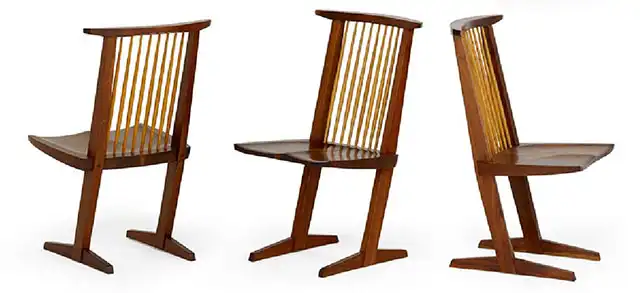
George Nakashima, American, 1905-1990, designer and maker
Walnut, hickory
One might wonder what a 1989 table is doing in a museum featuring objects from the American Arts and Crafts movement. Nakashima’s creations from the last half of the 20th century are often reflective of the same aesthetic values of Arts and Crafts practitioners such as Frank Lloyd Wright, Gustav Stickley, Greene and Greene and others. Nakashima valued tradition and simplicity in design and held a deep respect for the natural materials he worked with. His furniture was made by hand, one at a time, without extra color, frills, or embellishment. While he favored minimal technology, he accepted the machine as an aid to craftsmanship. In a way, George Nakashima’s work and philosophy might be deemed as a continuation of the American Arts and Crafts movement.
On March 1 2025, MAACM is excited to host a presentation by our honored speaker, Mira Nakashima-Yarnall discussing her father’s legacy, and her leadership of the Nakashima studio, creating works under her own name while carrying forth the methods and techniques embraced by her father.