Celebrating an Icon of American Design: Louis Comfort Tiffany
Born on February 18, 1848, Louis Comfort Tiffany would become one of the most influential figures in American decorative arts, illuminating the world with color, light, and extraordinary imagination.
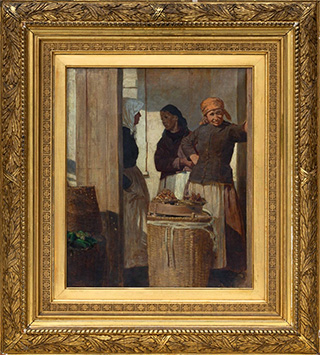
Louis Comfort Tiffany, American, 1848-1933
Oil on canvas
Carved and giltwood frame attributed to Stanford White and Louis Comfort Tiffany
Although he is most closely associated with the Art Nouveau movement and the transformation of American stained glass, Tiffany began his career as a painter. He studied under prominent American landscapists George Inness and Samuel Colman and later refined his skills in Paris as a painter of narrative subjects. Early travels through North Africa, Spain, and France profoundly shaped his artistic vision, immersing him in luminous landscapes, intricate architectural forms, and richly patterned surfaces. These experiences cultivated his lifelong fascination with color, atmosphere, and the expressive potential of light.
By the age of nineteen, Tiffany had helped found the American Society of Painters in Water Color and was exhibiting at the National Academy of Design. Upon returning to the United States, he developed an American Orientalist style, translating his impressions of foreign landscapes into evocative oils and watercolors. Yet his restless creativity soon pushed him beyond the canvas. His fascination with color and radiance ultimately led him to stained glass, where light itself became his primary medium.
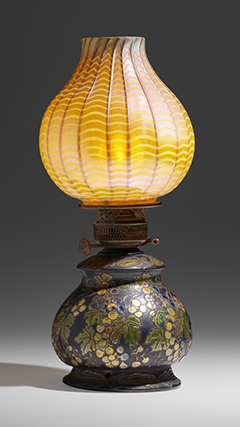
Tiffany Studios, manufacturer
Hand-blown Favrile glass, enameled bronze
Perhaps his most celebrated innovation was “Favrile” glass, a technique that blended molten glass to produce opalescent, iridescent surfaces alive with layered color. Unlike traditional stained glass, Favrile shimmered with internal luminosity. In lampshades, windows, and decorative objects, this material glowed warmly when illuminated and retained a subtle radiance even in ambient light — a poetic fusion of craftsmanship and atmosphere that became emblematic of American design at the turn of the century.
Under Tiffany’s direction, the studios expanded beyond glass to include metalwork, textiles, furniture, ceramics, and a wide range of decorative objects. The Fancy Goods Department, in particular, established a reputation for exceptional artistry in candlesticks, desk accessories, boxes, and other refined household objects, demonstrating the breadth of the studio’s creative vision.
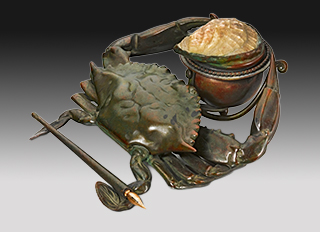
Tiffany Studios, manufacturer
patinated bronze, shell and glass
Today, visitors to MAACM can experience this legacy firsthand. Numerous Tiffany lamps glow throughout the galleries, alongside examples of finely crafted metalwork that reflect the studio’s commitment to artistry in every material. Together, these works reveal the remarkable range and enduring brilliance of Tiffany Studios.
Louis Comfort Tiffany’s legacy endures not only in the beauty of his designs but in his spirit of experimentation and innovation. From painter to designer, from traveler to visionary, his work continues to cast a radiant glow across generations.