Celebrating an Icon of American Design: Gustav Stickley
This month, we invite you to join us in celebrating the birth of Gustav Stickley, a visionary who reimagined what home, craftsmanship, and modern living could be in America. His guiding principles - simplicity, utility, and beauty - continue to resonate, offering a timeless approach to how we live with the objects around us.
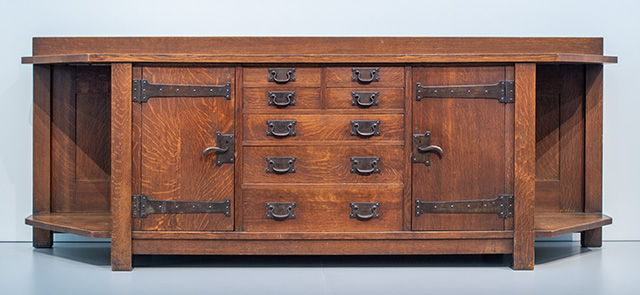
Craftsman Workshops, manufacturer
Oak, chestnut, iron
At the turn of the twentieth century, the American Arts and Crafts movement emerged as both a design revolution and a thoughtful response to the rise of industrialization. Inspired by voices like John Ruskin and William Morris, makers began to turn away from mass production in favor of something more meaningful. They embraced craftsmanship, honored the dignity of labor, and believed that the things we use every day should bring both purpose and joy.
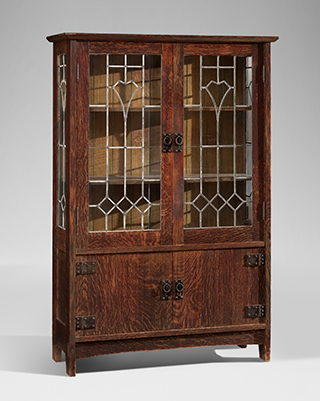
Henry W. Wilkinson, American, 1869-1931, designer
Craftsman Workshops, manufacturer
Oak, iron, glass
Gift from Gustav Stickley to his architect Lamont Warner
Gustav Stickley stood at the heart of this movement. In 1898, he founded his company, and soon after introduced his groundbreaking New Furniture line - pieces defined by honest construction, quality materials, and enduring character. By 1903, his Craftsman Workshops in upstate New York had become a hub for talented artisans and designers, all united by a shared commitment to thoughtful, well-made design.
The furniture created there was striking in its quiet confidence. Clean lines replaced ornamentation. Structural elements were revealed rather than hidden, transforming joinery and hardware into expressions of craftsmanship. Warm, natural woods and subtle decorative details created pieces that felt both grounded and graceful - designed not just to be seen, but to be lived with.
But Stickley's vision went beyond furniture. He imagined the entire home as a harmonious space, where architecture, furnishings, and daily life worked together seamlessly. Through his magazine, The Craftsman, along with catalogs and a growing network of retailers, he welcomed people into this way of living - one where beauty is part of the everyday.
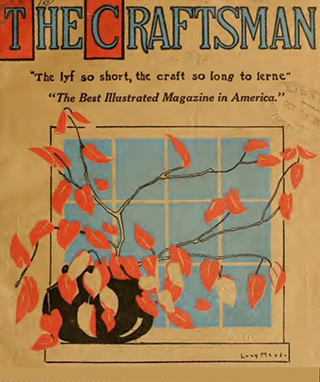
October, 1916
Craftsman Publishing Co., NY, NY
Though Craftsman Workshops closed in 1916, Stickley's influence has never faded. His work reminds us that simplicity can be rich with meaning, that usefulness can be elegant, and that true beauty begins with honesty in materials and purpose.
As we celebrate his birthday, we honor more than a master furniture maker - we celebrate a philosophy that still feels remarkably relevant today. Stickley's legacy invites us to slow down, to appreciate the work of skilled hands, and to create spaces filled with objects that are simple, useful, and beautifully made.