Collection Spotlight: The Making of the Eudora Welty Portfolio
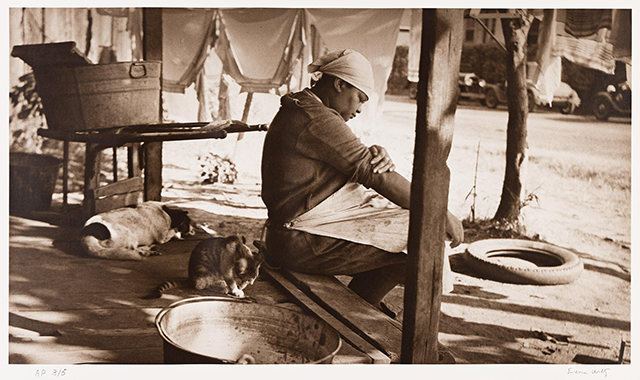
Eudora Welty, American, 1909-2001
Toned silver print on Agfa paper
Among the most significant recent acquisitions of the Two Red Roses Foundation is a remarkable artist’s proof portfolio of photographs by Eudora Welty, presented by the celebrated author to her longtime friend, journalist Robert MacNeil, in 1992. The portfolio, now on view in Faces of Inequality: Depression Era Photography at the Museum of the American Arts and Crafts Movement, offers an intimate look at a lesser-known aspect of Welty’s extraordinary creative life.
Before earning the Pulitzer Prize and becoming one of America’s most admired literary voices, Welty traveled throughout Mississippi during the 1930s and 1940s, photographing everyday people and places with uncommon sensitivity. Unlike many documentary photographers of the Depression era who sought to expose social injustice or advocate reform, Welty approached her subjects with empathy, humor, and quiet observation. Her camera found dignity in ordinary moments and revealed the humanity of people often overlooked by history.
One of the most revealing documents accompanying the Eudora Welty artist's proof portfolio is an essay written in 1992 by D. Gorton of Diogenes Editions. Intended to explain the production of the portfolio, the essay offers an unusually detailed account of Welty's direct involvement in creating what would become the definitive edition of her photographs.
The project began with an examination of more than one thousand negatives preserved at the Mississippi Department of Archives and History. Working with James Patterson and archival staff, Gorton helped identify approximately seventy-five photographs that represented the breadth of Welty's photographic work. From this group, Welty personally selected the final eighteen images included in the portfolio. Her participation extended beyond image selection. She approved the design and color of the portfolio case and worked closely with the printers throughout production.
The technical challenges were substantial. Many of the negatives were nearly sixty years old and reflected the limitations of Depression-era processing. Overdevelopment, chemical contamination, and physical deterioration had left visible flaws throughout the archive. Despite these imperfections, Welty insisted that the photographs receive only minimal retouching. The sole exception was Farmers in Town, where damage had nearly obscured a sitter's face. Even there, she approved only the restoration of the face itself, preserving the remainder of the negative's original condition.
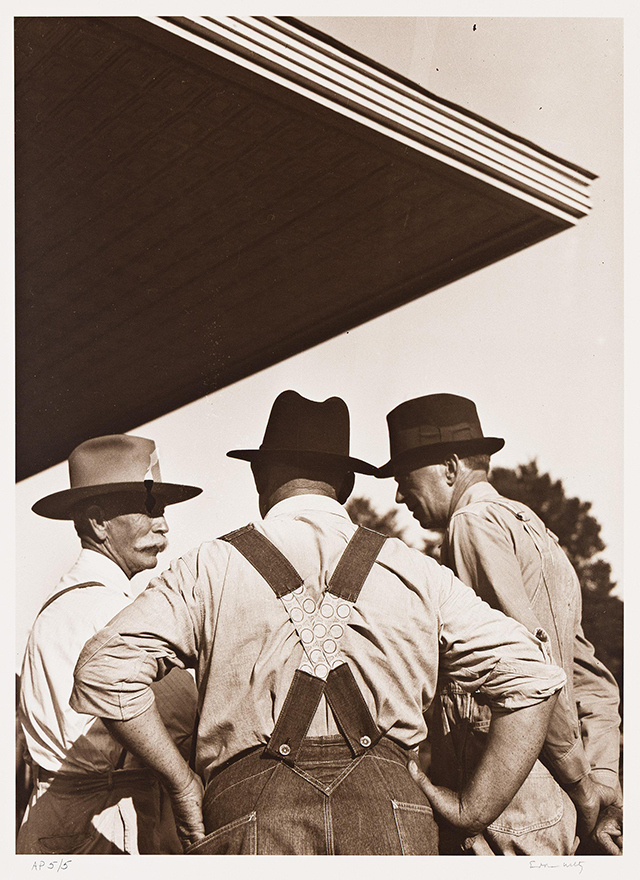
Eudora Welty, American, 1909-2001
Toned silver print on Agfa paper
Welty was equally engaged in determining the appearance of the final prints. After reviewing multiple combinations of paper, developers, and toners, she selected silver-rich Agfa 118 paper combined with a brown toner, favoring a subdued and atmospheric presentation rather than a high-contrast modern interpretation. Gorton noted that the enlarged 16” x 20” prints often revealed details that had been difficult to see in earlier prints, prompting Welty to rediscover aspects of her own photographs.
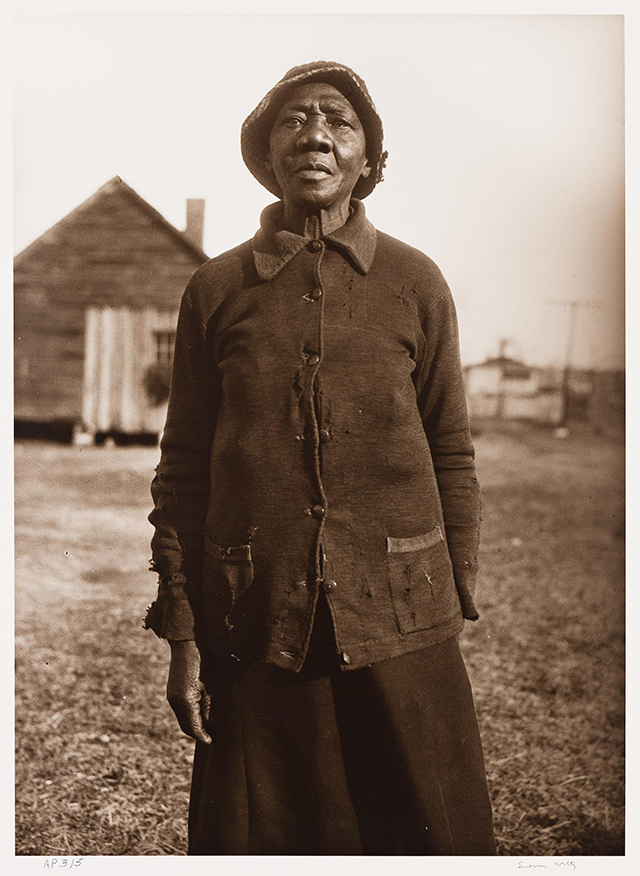
Eudora Welty, American, 1909-2001
Toned silver print on Agfa paper
Perhaps most revealing are Welty's comments about individual images. She identified A Woman of the Thirties as her favorite photograph, admiring both the dignity of the sitter and the texture of her carefully mended clothing. Throughout the project she repeatedly spoke about texture and surface, drawing attention to details that many viewers might overlook: the woven patterns of quilts, the folds of a farmer's shirt, and the way a marble cemetery monument appeared to float among fallen leaves. Such observations demonstrate that Welty's photographs were not simply documentary records. They were carefully observed studies of form, character, and visual poetry.
The resulting edition consisted of sixty portfolios and five artist's proof sets, each produced under Welty's supervision and approved against a set of master prints. Gorton's account confirms that the portfolio was far more than a retrospective publication. It was a final collaboration between photographer and printer, allowing Welty to revisit, refine, and ultimately define how future generations would encounter some of the most enduring images of twentieth-century Southern life.