A Stunning Arts & Crafts Fireplace: A Mayan Revival
Published by the Two Red Roses Foundation, March 3, 2015
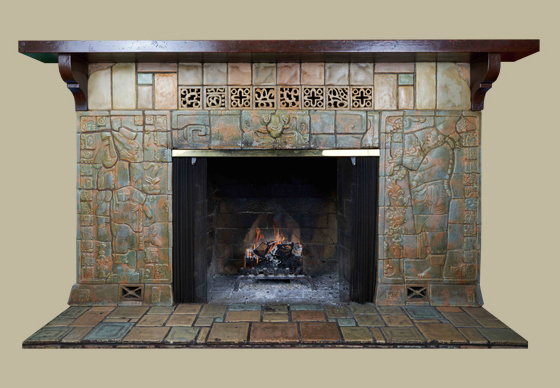
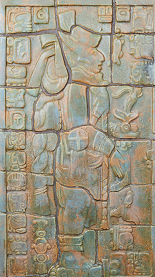 The Two Red Roses Foundation adds to its collection of Arts and Crafts fireplaces a rare Mayan Revival fireplace made by Calco, South Gate, California (1923-1932). Under owner Rufus Bradley Keeler's direction, Calco made several Mayan revival fireplace sets. Over the past 25 years, the Tile Heritage Foundation and Riley Doty, a ceramic tile setter and tile historian, have discovered four of them in the Bay Area, including this one at Montclair Women's Club in Oakland. The Club will be sold in the summer and TRRF is delighted to have the opportunity to preserve this historical fireplace.
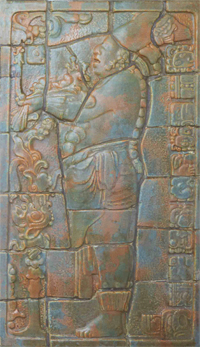 The Foundation will oversee its removal, (including the beautiful hearth), and shipment to Florida, where it will be reconstructed and exhibited in the planned Museum of the American Arts and Crafts in St. Petersburg. The set will be displayed in a special exhibit space dedicated to fireplaces and mantles produced by the Rookwood Company, the Hartford Faience Co., and the Grueby Tile and Faience Company. Riley Doty explains:
"At Palenque (southern Mexico), there are three small temples facing one another around a small plaza - the Temple of the Sun, The Temple of the Cross, and the Temple of the Foliated Cross. Keeler's fireplace is based on the panels of the Temple of the Cross. The original carving was removed from Palenque decades ago so that it could be displayed in The National Museum of Anthropology in Mexico City, where it still resides."
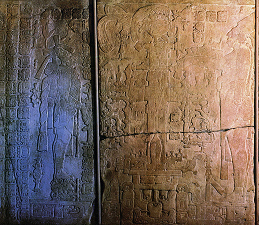
"For centuries it was customary to plunder archeological sites for choice pieces to display in preeminent museums. In the 1920s, U.S. newspapers and magazines carried stories of the discoveries of Mayan ruins in the jungles of southern Mexico. "Mayan Revival" became a new design source which many found refreshing, following a long period in which nearly all design had been rooted in European sources and vocabulary."
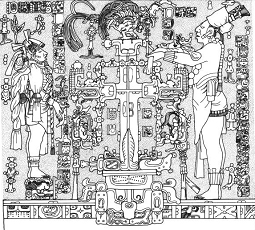
Certainly the most stunning Mayan fireplace built by Calco is the monumental set Keeler built for his own house in South Gate. The house has been preserved practically untouched and in its original beauty by its current owner, Brian L. Kaiser, who writes: "Each room has floor tiles of a distinct color and pattern with ceramic baseboards enhanced with wisteria, clematis, and yellow roses." Kaiser adds, "Keeler liked creating new glazes, rich and brilliant colors, in stark contrast to the muted, somber tones of tile makers like Batchelder. He was deeply concerned with the quality of his clay mixture and the manner in which the tiles were fired".
For more information on Calco and Rufus Keeler, see Joseph Taylor's California Tile: The Golden Era, 1910-1940. Acme to Handcraft, pp. 94-109, and The Arts and Crafts Movement in California: Living the Good Life, pp. 120-121, 124.