Thomas Pollock Anshutz: American Realist and Influential Educator
Thomas Pollock Anshutz (October 5, 1851 - June 16, 1912) was an American painter and teacher best known for his realist portraiture, genre scenes, and profound influence on American art education. Though he produced a relatively small body of work - around 130 oil paintings - his legacy endures through his teaching and the many prominent artists he mentored.
Born in Newport, Kentucky, Anshutz grew up in Wheeling, West Virginia. He began his formal art education in the early 1870s at the National Academy of Design in New York, studying under Lemuel Wilmarth. Dissatisfied with the traditional, cast-based instruction, he moved to Philadelphia in 1875 to enroll in life classes at the Philadelphia Sketch Club, where he met Thomas Eakins, who would become his mentor and a lifelong influence.
In 1876, Anshutz joined the Pennsylvania Academy of the Fine Arts (PAFA), studying under Christian Schussele and continuing his relationship with Eakins. By 1878, Anshutz became Eakins's assistant and later succeeded him as Chief Demonstrator. When Eakins resigned in 1886 amid controversy, Anshutz was appointed head of painting instruction and, in 1909, became head of the PAFA faculty.
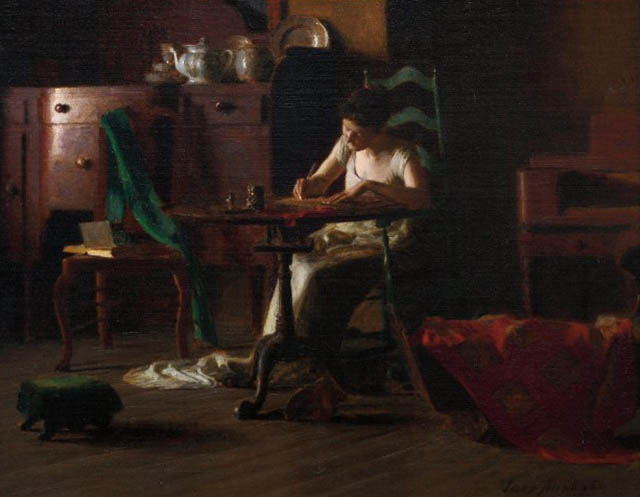
Thomas Pollock Anshutz, American, 1851-1912
Oil on canvas
Anshutz shared Eakins's commitment to realism and study from life, embracing the use of photography in art education. He took photographs of posed models to study anatomy and movement and assisted Eadweard Muybridge with motion photography experiments. His teaching philosophy emphasized form, structure, and observation over rigid academic detail.
A devoted educator, Anshutz influenced many key figures in early 20th-century American art, including Robert Henri, John Sloan, George Luks, William Glackens, Charles Sheeler, Everett Shinn, and Maxfield Parrish. These artists went on to define the Ashcan School and American modernism, carrying forward Anshutz's realist ideals with individual expression.
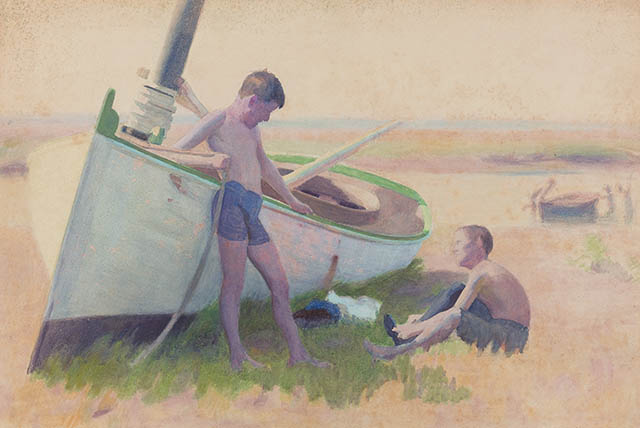
Thomas Pollock Anshutz, American, 1851-1912
Oil on canvas
In 1892, Anshutz married Effie Shriver Russell. They honeymooned in Paris, where he studied briefly at the Academie Julian before returning to Philadelphia. In 1898, he co-founded the Darby School with Hugh Breckenridge, a summer art school near Philadelphia focused on plein air painting. There, Anshutz produced some of his most vibrant and experimental landscapes, though many remained unexhibited.
Throughout his career, Anshutz was active in numerous art organizations, including the National Academy of Design and the Philadelphia Sketch Club, where he served as president. He exhibited regularly at both PAFA and the National Academy, earning respect in Philadelphia and New York's art circles.
Although his work extended into photography and landscape painting, Anshutz was best known for his portraits. His paintings often reflected the values of leisure, intellect, and refinement, especially in depictions of women, echoing both academic traditions and modern sensibilities.
Anshutz retired in 1911 due to declining health and died the following year. Despite his limited artistic output, his legacy endures through the generations of artists he shaped and the institutions he helped guide. His work remains in major public and private collections, including the Pennsylvania Academy of the Fine Arts, the Fine Arts Museums of San Francisco, the Two Red Roses Foundation, and Yale University Art Gallery.
A bridge between academic realism and modern American art, Thomas Anshutz remains a pivotal figure in American art history - more remembered today as a mentor than a painter, yet no less significant for it.