A Life in Craft: Celebrating Ernest Batchelder (1875–1957)
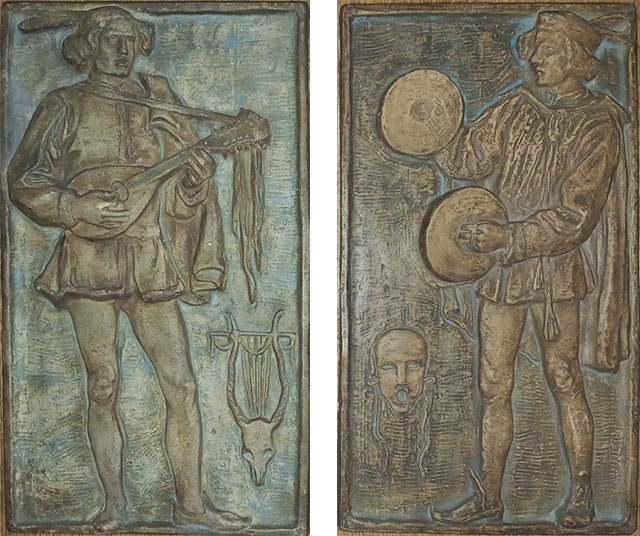
Buff clay body with mineral slip
Born in 1875, Ernest Allan Batchelder stands as one of the most influential figures of the American Arts and Crafts Movement and a defining force in shaping its distinctive California expression. Designer, craftsman, and educator, Batchelder devoted his life to the belief that art should be both beautiful and inseparable from everyday living—a philosophy that guided his work and enduring legacy.
In the early twentieth century, Batchelder designed and built the Batchelder House, a bungalow overlooking Pasadena’s Arroyo Seco. More than a private residence, the house quickly became a vital gathering place for artists, designers, and intellectuals associated with the Southern California Arts and Crafts movement. It was here that Batchelder constructed his kiln and began producing the art tiles that would bring him national recognition. Fired using engobes—colored slips wiped from raised surfaces so that pigment remained in recessed areas—his tiles were admired for their soft, matte, timeworn appearance. Their imagery drew from a rich range of sources, including medieval and Byzantine art, Mayan motifs, geometric patterning, abundant flora and fauna, and one of Batchelder’s most enduring symbols: the peacock.
Batchelder tiles soon appeared in homes, commercial buildings, and apartment lobbies across the United States, including prominent installations in New York City. Today, many of these iconic works can be seen in the Tile Gallery at the Museum of the American Arts and Crafts Movement (MAACM), as well as throughout the museum’s garden, where their quiet beauty continues to resonate.
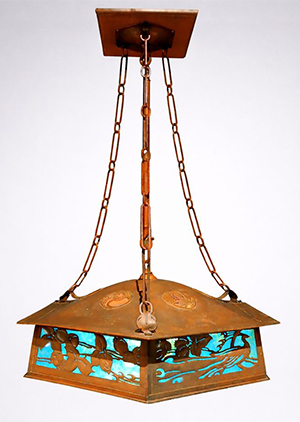
Ernest Allen Batchelder, American, 1875-1957, designer and manufacturer
Douglas Donaldson, American, 1882-1972, designer and manufacturer
Copper and stained glass
49 ½ x 34 x 29 ½
In 1912, Batchelder expanded his enterprise by founding Batchelder and Brown, later known as the Batchelder-Wilson Company. Specializing in hand-pressed relief tiles, the firm grew rapidly. By 1924, the operation included eleven kilns, a mechanized production line, and a workforce of 175 artisans. Although the company closed in 1932 as a result of the Great Depression, Batchelder’s influence endured.
Ernest Batchelder died in 1957, but his achievements remain vividly present in clay, metal, and in the ideals of the Arts and Crafts Movement itself. From the tiles that continue to grace walls and hearths across the nation to the luminous chandelier that still captivates viewers today, his work stands as a lasting testament to the power of craftsmanship, creativity, and thoughtful design.