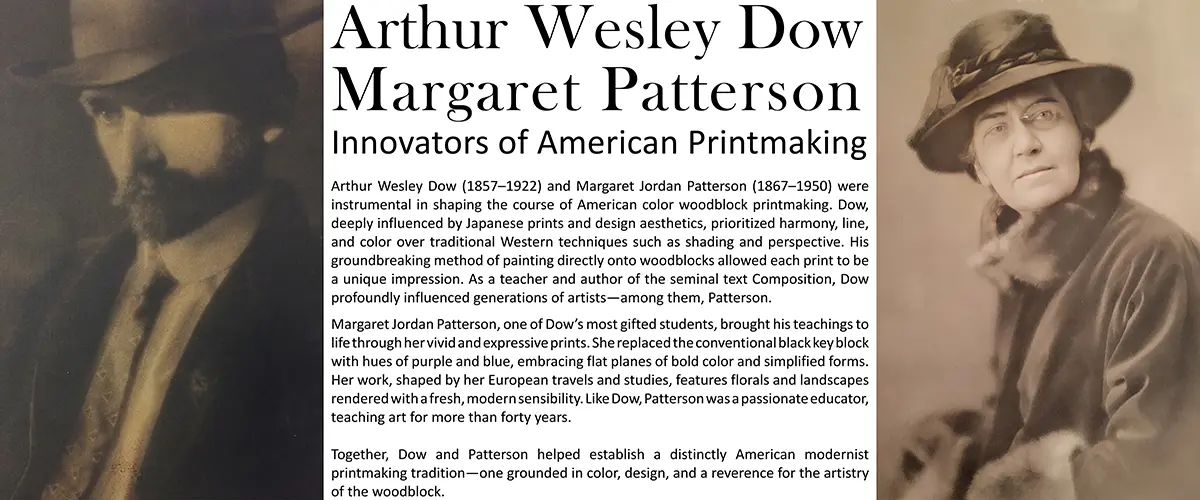
Arthur Wesley Dow & Margaret Patterson
Innovators of American Printmaking
May 13, 2026 - Ongoing
Arthur Wesley Dow (1857–1922) and Margaret Jordan Patterson (1867–1950) were instrumental in shaping the course of American color woodblock printmaking. Dow, deeply influenced by Japanese prints and design aesthetics, prioritized harmony, line, and color over traditional Western techniques such as shading and perspective. His groundbreaking method of painting directly onto woodblocks allowed each print to be a unique impression. As a teacher and author of the seminal text Composition, Dow profoundly influenced generations of artists—among them, Patterson.
Margaret Jordan Patterson, one of Dow’s most gifted students, brought his teachings to life through her vivid and expressive prints. She replaced the conventional black key block with hues of purple and blue, embracing flat planes of bold color and simplified forms. Her work, shaped by her European travels and studies, features florals and landscapes rendered with a fresh, modern sensibility. Like Dow, Patterson was a passionate educator, teaching art for more than forty years.
Together, Dow and Patterson helped establish a distinctly American modernist printmaking tradition—one grounded in color, design, and a reverence for the artistry of the woodblock.