Charles Prendergast: Frame-Maker and Post-Impressionist Visionary
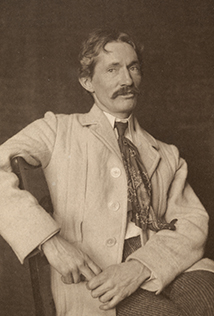 Charles Prendergast was a multifaceted artist whose legacy bridges the decorative and fine arts. Celebrated for his masterful frame-making and richly decorative paintings, Prendergast played a significant role in shaping the aesthetics of American Post-Impressionism. Born and raised in Boston, he began his career as a woodworker before turning to art, a transition that would define his unconventional artistic path.
Unlike many of his contemporaries, Prendergast received no formal art training until his late twenties. In 1890, at the age of 27, he traveled to Paris with his older brother, Maurice Prendergast (1858-1924), an established painter, to study at the Academie Julian. His stay was brief, and he returned to Boston in 1892.

Charles Prendergast, maker
Outside dims: 43 ¾” x 33 ¾”
By 1895, Prendergast had turned to frame-making, producing intricate, hand-carved works that reflected the ideals of the Arts and Crafts movement. His frames, often gilded and richly ornamented, quickly gained a following among artists, including his brother and John Singer Sargent. His reputation grew further when his frames were exhibited at the 1913 Armory Show and later commissioned for works in prestigious collections such as the Barnes Foundation. At times, demand was so high that he enlisted Maurice's help to fulfill commissions.
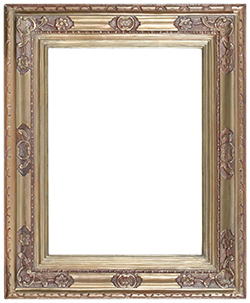
Charles Prendergast, maker
Outside dims: 27 ½ x 33 ½ inches.
A pivotal trip to Italy in 1898 profoundly influenced Prendergast's aesthetic. He was captivated by the art and architecture of Venice, a passion that informed both his painting style and the decorative character of his frames. In 1903, he co-founded the Carrig-Rohane frame shop in Winchester, Massachusetts, with Hermann Dudley Murphy. The shop relocated to Boston in 1905 and soon employed Swedish woodcarver Walfred Thulin. Although a co-founder, the extent of Prendergast's ongoing involvement in the business remains unclear.
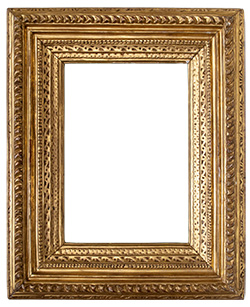
Charles Prendergast, maker
Outside dims: 20 x 26 ¼ inches
In 1914, Charles moved to New York with Maurice, where he began experimenting with panel painting. Working on carved wooden surfaces coated with gesso, he employed gold leaf, vibrant colors, and stylized forms influenced by medieval and Renaissance art. Over the course of his career, he produced approximately 400 frames, 100 panel paintings, and various decorative objects including screens, chests, and sculptures.
Though he began as a craftsman, Charles Prendergast evolved into a significant figure in American art. He continued creating both frames and paintings until his death in 1948, leaving a lasting legacy defined by artistic innovation, technical mastery, and the seamless integration of art and ornament.
Visitors can view a selection of his original frames, along with examples by other leading frame makers of the period, in the exhibition Masterworks of American Frame Design at the Museum of the American Arts and Crafts Movement.